
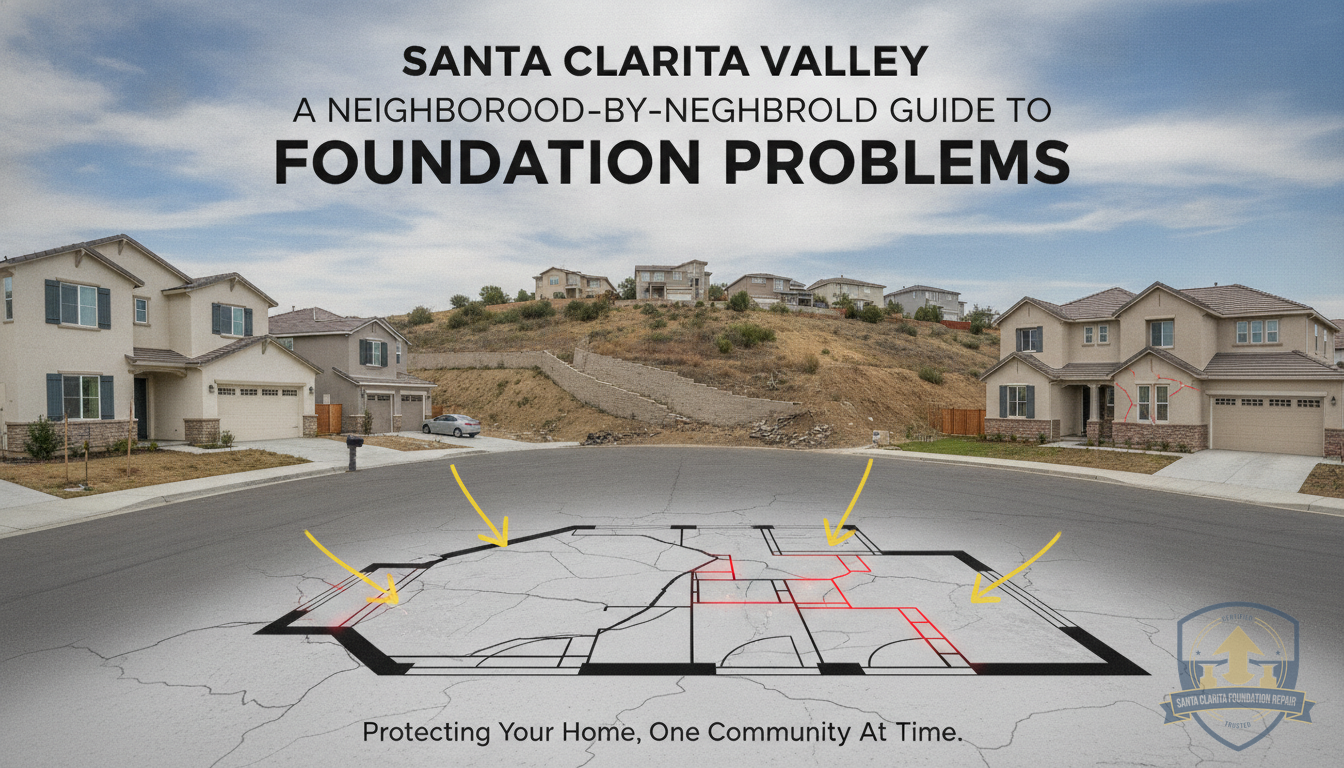
Why Location Matters for Foundation Health
Two homes built the same year with the same floor plan can have dramatically different foundation histories depending on which part of the Santa Clarita Valley they sit in. Elevation, proximity to hillsides, soil composition, drainage patterns, and even the age of the surrounding street infrastructure all influence how a foundation performs over time. Understanding the specific risk profile for your neighborhood helps you know what to watch for and when to call for an inspection before minor issues become expensive repairs.
Santa Clarita Foundation Repair serves every community in the valley, and over time our team has developed a clear picture of the foundation challenges most common in each area. Here is what we see most frequently—and which services address those concerns most effectively.
Valencia: Master-Planned Lots With Irrigation Challenges
Valencia is one of the most meticulously developed communities in Los Angeles County, with consistent grading standards and well-maintained infrastructure. But master-planned does not mean foundation-proof. The extensive paseo and parkway system in Valencia encourages dense landscaping, and homeowners association standards often require lush turf and shrub coverage close to homes—which means irrigation systems run frequently and deliver significant moisture into the soil surrounding foundations year-round.
The result is that many Valencia homes experience foundation movement not from drought-related shrinkage but from over-saturation: clay soils that are kept consistently wet swell and exert upward and lateral pressure on slabs and stem walls. We see a higher-than-average rate of foundation crack repair calls from Valencia homeowners dealing with diagonal cracks near window corners and sticking exterior doors—both classic indicators of differential heaving.
Homes in Valencia are also relatively newer, which means pier and beam construction is less common and slab-on-grade is the dominant foundation type. Slab foundation leveling using polyurethane foam injection is a frequently used solution here because it corrects settlement with minimal disruption to landscaping and interior finishes that Valencia homeowners have invested significantly in maintaining.
Learn more about our services in Valencia, or explore our full foundation waterproofing options if your Valencia home has irrigation-related moisture concerns.
Newhall: Older Homes With Pier and Beam Foundations
Newhall is the oldest neighborhood in the Santa Clarita area, and with age comes a very different set of foundation concerns than newer master-planned communities. Properties built before the 1970s in Newhall frequently have pier and beam construction with wood posts, wood beams, and open crawl spaces—a system that was standard at the time but that requires ongoing attention to remain structurally sound.
Decades of seasonal moisture cycling in unencapsulated crawl spaces leads to wood rot in beams and posts, which causes floors to sag, spring, or develop noticeable slopes. Termite damage, which often goes undetected in crawl spaces for years, compounds the structural degradation. By the time a Newhall homeowner notices a floor that feels soft underfoot or a door frame that has racked out of square, the crawl space may have significant deterioration affecting multiple support points.
Our most common project scope in Newhall combines pier and beam foundation repair—replacing deteriorated posts with steel or concrete equivalents, sistering damaged beams, and shimming piers back to level—with crawl space encapsulation to eliminate the moisture environment that caused the damage in the first place. Addressing both in a single project is more cost-effective than treating them separately and produces a lasting result.
Read more about our work in Newhall, or visit our pier and beam repair page for Newhall homeowners specifically.
Saugus: Mixed Housing Stock and Variable Soil Conditions
Saugus presents a mixed picture because it encompasses both older ranch-style neighborhoods developed in the 1960s and 1970s and newer subdivisions built in the 2000s. The older stock shares many of the pier and beam concerns seen in Newhall, while newer construction is almost entirely slab-on-grade.
What distinguishes Saugus from a geotechnical standpoint is variability. The area sits near the eastern edge of the Ventura basin where alluvial fan deposits from the Santa Clara River create pockets of different soil types in close proximity. This means that two homes on the same block can have meaningfully different soil bearing capacity beneath their foundations, making differential settlement more common here than in areas with more uniform geology.
Saugus homeowners frequently contact us about uneven floors in older slab homes—a pattern consistent with voids forming beneath the concrete as alluvial soils compact unevenly under load. We also see a notable number of helical pier installation projects in Saugus where ongoing differential settlement has made surface-level repairs insufficient and permanent pier anchoring to stable soil is the right long-term solution.
Explore our service area coverage for Saugus and our slab foundation leveling options if you have noticed floor slopes in a Saugus home.
Canyon Country: Hillside Lots and High-Clay Soils
Canyon Country presents some of the most challenging foundation conditions in the Santa Clarita Valley. Many homes in this neighborhood are built on hillside lots or cut-and-fill pads—a construction method where the top of a slope is cut away and the removed soil is used to fill the lower portion of the lot to create a flat building pad. Cut-and-fill construction creates a transition zone beneath the foundation where native cut soil meets compacted fill, and these two materials respond differently to moisture changes, almost guaranteeing differential settlement over time.
Canyon Country also has some of the highest clay content soils in the valley. The combination of high clay content and hillside drainage that concentrates runoff against upslope foundation walls creates significant lateral pressure, particularly after wet winters. Horizontal cracking in stem walls is more common here than anywhere else in our service area.
We regularly perform foundation crack repair paired with carbon fiber strap reinforcement on Canyon Country stem walls to arrest horizontal cracking before it progresses. For homes on steeper lots, helical pier installation stabilizes the foundation against continued downslope creep. Exterior foundation waterproofing with drainage board and gravel backfill is especially important here given the hillside drainage volumes these properties receive.
Visit our Canyon Country service area page for more information on what our team commonly encounters in this neighborhood.
Stevenson Ranch: Hillside Luxury Homes That Require Proactive Monitoring
Stevenson Ranch is a comparatively newer community with high-quality home construction, but its hillside topography and proximity to the Santa Susana Mountains create foundation risks that many residents do not anticipate. Large, custom-built homes on sloped lots carry significant structural loads that must be transferred to stable soil through carefully designed foundation systems—and when those systems were not originally designed with worst-case moisture conditions in mind, they can struggle during particularly wet winters.
The most common call we receive from Stevenson Ranch homeowners involves settlement in larger slab homes where one wing or addition has settled relative to the main structure, creating a visible step at interior doorways and cracked tile floors. This pattern is consistent with fill soil under the newer portion of a structure consolidating over time—a known risk when additions are built on compacted fill pads without engineered pier support extending to native soil.
Our helical pier installation service for Stevenson Ranch provides the engineered solution these properties need. Because pier installation requires only compact equipment and minimal excavation at each bracket location, we can work effectively on the tight side yards and sloped terrain common on Stevenson Ranch lots without disturbing mature landscaping. After pier stabilization, we assess whether foundation crack repair is needed to close any gaps that opened during the settlement period.
Learn more about our coverage in Stevenson Ranch.
Castaic: Rural-Edge Properties and Expansive Terrain
Castaic occupies the northern edge of our service area, situated in the Castaic Valley where the terrain is more rugged and lot sizes are often larger than in the closer-in Santa Clarita neighborhoods. Homes here range from modest ranch-style construction to larger rural properties, and many were built at a time when soil testing and engineering oversight were less rigorous than current standards require.
We see a range of foundation types in Castaic, including both slab-on-grade and pier and beam construction. The area's expansive soils are similar in composition to Canyon Country, and the lack of consistent municipal water and sewer infrastructure in older parts of Castaic means that septic system leaks and private well irrigation can create localized areas of excessive soil moisture that accelerate foundation movement.
Common projects in Castaic include pier and beam foundation repair for older ranch homes with deteriorated wood crawl space systems, slab foundation leveling using foam injection for settled garage or home addition slabs, and comprehensive foundation waterproofing for properties where grading issues have allowed water to pool against the structure for years.