The Hidden Force Under Your Santa Clarita Home
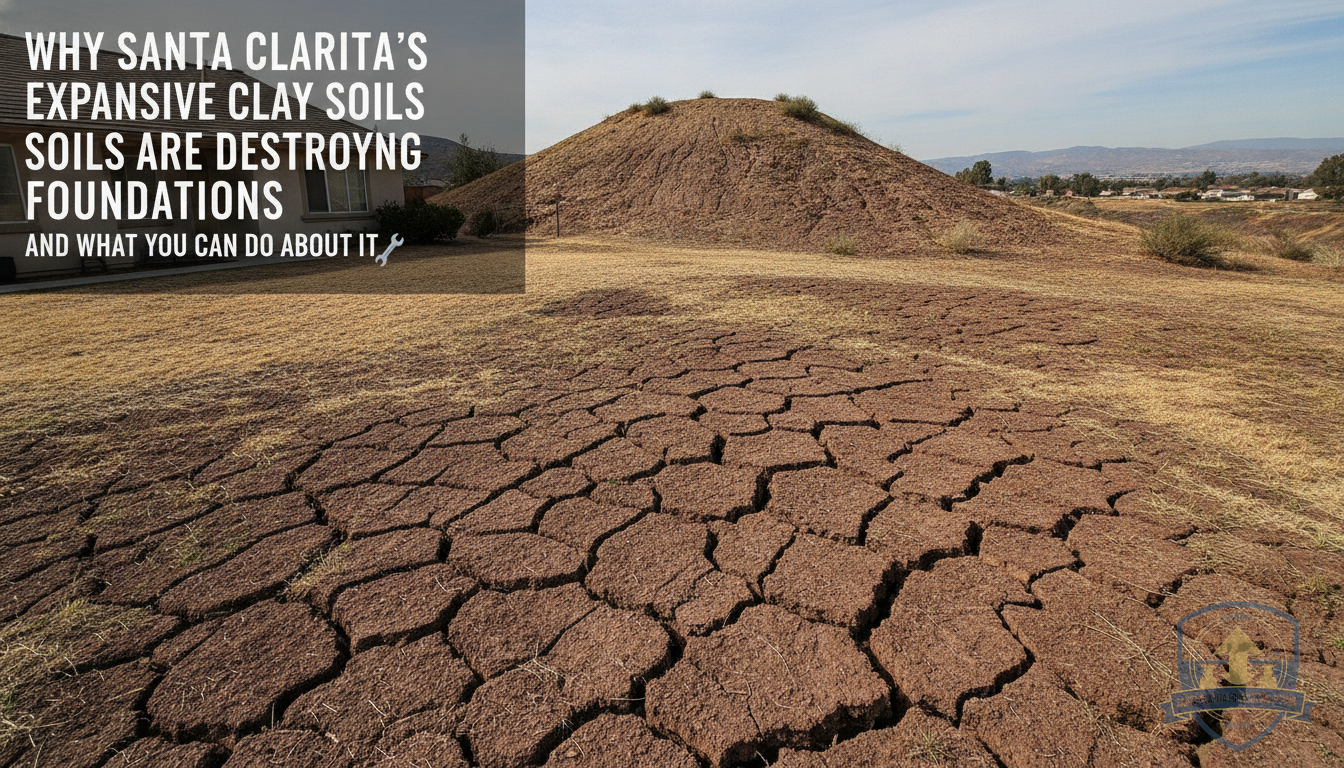
Most homeowners think about foundation problems only after they see a crack in the wall or a door that suddenly won't close. But the real story starts beneath the slab or crawl space, in the layers of expansive clay soil that underlie much of the Santa Clarita Valley. These soils—often called Vertic or smectite-rich clays—absorb water and swell, then release it and shrink, sometimes moving several inches in a single season. Over years and decades, that relentless push-and-pull cycle works against even well-built concrete foundations.
Understanding what's happening underground is the first step toward protecting your home. In this article we walk through how expansive soils damage foundations, what symptoms to watch for, and which professional repair options are most effective in our region.
How Expansive Clay Causes Foundation Movement
When Santa Clarita's dry summers pull moisture out of the soil, clay particles lose volume and the ground contracts. Sections of a concrete slab or the piers beneath a wood-framed floor lose support and begin to settle—sometimes uniformly, but more often in an uneven pattern called differential settlement. When winter rains or landscape irrigation reintroduce moisture, the clay swells back, sometimes unevenly, and can actually push sections of the foundation upward (a process called heaving).
This cycle creates several destructive forces simultaneously:
- Tension and compression stress on the concrete slab, producing diagonal and stair-step cracks
- Lateral pressure against basement and stem walls as saturated soil expands outward
- Void formation beneath slabs as soil shrinks away, removing load support
- Wood rot acceleration in pier and beam crawl spaces where soil moisture fluctuation creates persistent humidity
Neighborhoods across the Santa Clarita Valley are affected, from the hillside lots of Canyon Country and Stevenson Ranch to the older residential streets of Newhall and the established communities of Saugus.
Warning Signs That Your Foundation Is Under Stress
Expansive soil damage rarely announces itself dramatically. Instead, it accumulates quietly through small changes that homeowners often attribute to normal settling. Here are the key warning signs to take seriously:
- Diagonal cracks running from the corners of door frames and window openings
- Stair-step cracks along brick or block exterior walls
- Horizontal cracks in basement or crawl space stem walls—these indicate lateral soil pressure and are among the most serious patterns
- Floors that feel springy, slope visibly, or have tile grout that is cracking in lines
- Interior doors and windows that stick, bind, or no longer latch properly
- Visible gaps opening between wall surfaces and ceilings or floors
- Exterior concrete stoops or garage slabs that have settled away from the main structure
If you are seeing two or more of these signs at the same time, the underlying cause is almost certainly foundation movement rather than cosmetic settling. A professional inspection will determine whether the movement is active or has stabilized—a critical distinction for choosing the right repair method.
Repair Solutions Matched to Soil Conditions
Not every foundation problem calls for the same fix. The right approach depends on the type of foundation you have, whether movement is ongoing, how severe the displacement is, and what the drainage conditions look like around your property. Here is how the most common repair strategies apply to Santa Clarita's expansive soil environment.
Foundation Crack Repair
Cracks are the most visible evidence of soil movement, but patching them without addressing the cause is a short-term measure. Our foundation crack repair service evaluates each crack's orientation, width, and history to determine whether epoxy injection, polyurethane foam, or carbon fiber reinforcement is the appropriate solution. For homes in Valencia and other master-planned communities where landscaping irrigation is heavy, addressing drainage before sealing cracks is especially important.
Slab Foundation Leveling
When clay shrinkage has created voids beneath a concrete slab, the slab loses support and drops. Polyurethane foam injection fills those voids and lifts the slab back toward level without major excavation. For deeper or ongoing settlement, steel pier systems provide a permanent solution anchored below the active soil zone. Learn more on our slab foundation leveling page, or see how we serve slab homes specifically in Valencia and Canyon Country.
Helical Pier Installation
When settlement is severe or still progressing, surface repairs alone will not hold. Helical pier installation drives steel shafts through the unstable clay layers and anchors your foundation to competent load-bearing soil or bedrock far below the zone of seasonal moisture change. This is the most reliable long-term solution for hillside properties in Stevenson Ranch and sloped lots throughout Castaic.
Foundation Waterproofing
Because moisture is the engine driving clay expansion, controlling how water reaches your foundation is as important as any structural repair. Our